Union Budget 2026 Highlights: Sector-Wise Growth, Investment & Percentage Increase Explained
Union Budget 2026 Highlights :
The Union Budget 2026–27, presented on 1 February 2026 by Finance Minister Nirmala Sitharaman, focuses on economic growth, infrastructure expansion, manufacturing strength, and inclusive development. The government has taken a balanced approach by increasing capital investment while keeping fiscal discipline intact.
This article explains what happened in Budget 2026, how much investment was announced, which sectors saw percentage growth, and how it impacts common people, in a simple and structured way.
1. Overall Budget Snapshot
- Total Government Expenditure: ₹53.5 lakh crore (↑ approx. 8% from previous year)
- Total Revenue Receipts: ₹36.5 lakh crore
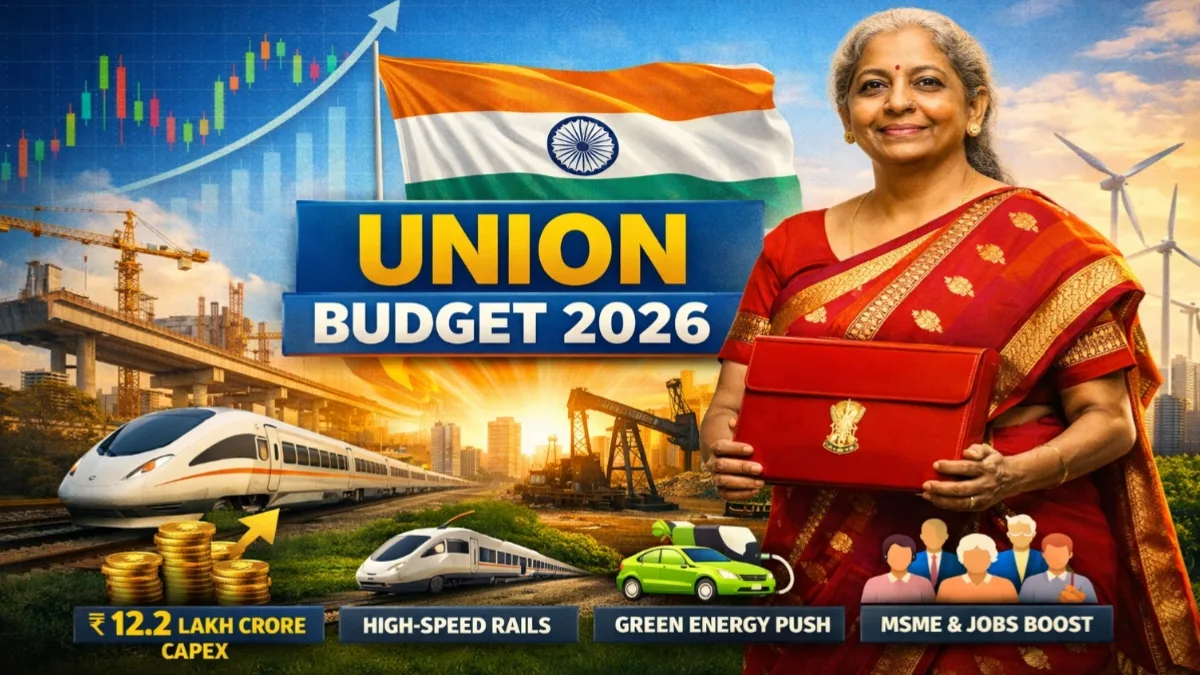
- Capital Expenditure (Capex): ₹12.2 lakh crore (↑ nearly 11%)
- Fiscal Deficit: 4.3% of GDP
- GDP Growth Target: 6.5% – 7%
The government clearly prioritised long-term asset creation over short-term freebies.
2. Infrastructure Development: Biggest Winner
Infrastructure remained the backbone of Budget 2026.
- Total Infrastructure Allocation: ₹12.2 lakh crore
- Year-on-Year Increase: ~11%
- 7 new high-speed rail corridors announced
- 20 new National Waterways approved
- Major funding for highways, ports, logistics parks
This massive investment is expected to generate lakhs of jobs and boost cement, steel, and construction industries.
3. Railways & Transport Investment
- Railway Allocation: ₹2.9 lakh crore
- Increase: approx. 9%
- Focus on semi-high-speed trains
- Station redevelopment projects expanded
- Green rail energy initiatives launched
The transport sector aims to improve connectivity while reducing carbon emissions.
4. Manufacturing & Industrial Growth
To strengthen “Make in India,” the government pushed manufacturing investments.
- Semiconductor Mission 2.0: ₹75,000 crore allocation
- Manufacturing Growth Support: ↑ 10%
- New incentives for electronics & chip manufacturing
- Textile parks expansion under PM MITRA scheme
This move positions India as a global manufacturing hub.
5. MSME & Startup Boost
- MSME Growth Fund: ₹20,000 crore
- Credit guarantee coverage expanded by 25%
- Interest subsidy for small businesses
- Startup tax compliance simplified
MSMEs contribute nearly 30% to India’s GDP, and this budget strengthens their backbone.
6. Green Energy & Climate Investment
Budget 2026 strongly supports sustainable development.
- Green Energy Allocation: ₹1.1 lakh crore
- Increase: approx. 18%
- Solar panel & battery manufacturing incentives
- Electric vehicle (EV) infrastructure expansion
- ₹20,000 crore for Carbon Capture & Storage (CCUS)
This investment supports India’s net-zero commitment.
7. Tax Announcements & Income Tax Changes
- No major change in income tax slabs
- New Income Tax Act effective from April 1, 2026
- TCS on foreign tour packages reduced to 2%
- STT increased on derivatives trading
The focus remained on tax simplification rather than tax cuts.
8. Agriculture & Rural Economy
- Agriculture Allocation: ₹1.9 lakh crore
- Increase: approx. 7%
- New agri-storage & cold-chain projects
- Digital farming & agri-tech support
- Rural employment programs expanded
This supports farmer income stability and food security.
9. Education, Health & Social Welfare
- Education Budget: ↑ 6%
- Health Budget: ↑ 8%
- More AIIMS & medical colleges
- Digital education platforms expanded
- Women & youth skill programs funded
The government focused on human capital development.
10. How Budget 2026 Impacts Common People
- More jobs through infrastructure projects
- Stable tax structure for middle class
- Improved transport and logistics
- Cleaner energy and better urban facilities
Though direct cash benefits are limited, long-term gains are significant.
Frequently Asked Questions (FAQ)
Q1. What is the main focus of Union Budget 2026?
The main focus is infrastructure growth, manufacturing expansion, green energy, and fiscal stability.
Q2. How much capital expenditure increased in Budget 2026?
Capital expenditure increased by nearly 11% to ₹12.2 lakh crore.
Q3. Did income tax slabs change in Budget 2026?
No major changes were made to income tax slabs.
Q4. Which sector received the highest investment?
Infrastructure and transport sectors received the highest allocation.
Q5. Is Budget 2026 good for long-term growth?
Yes, experts believe Budget 2026 supports sustainable and long-term economic growth.
Conclusion
The Union Budget 2026–27 is a growth-oriented and future-ready budget. With strong capital investment, controlled fiscal deficit, and focus on green energy and manufacturing, the government aims to strengthen India’s economy for the next decade.
While short-term relief is limited, the long-term impact on employment, infrastructure, and industrial growth makes Budget 2026 a strategic and forward-looking financial plan.

✍ Author: Indrajit Mandal
Digital Content Creator & Blogger. I share educational information about finance, government schemes, and educational technology.
📺 YouTube